
Reducing Neck and Shoulder Stiffness — Essential Care Habits for Office Workers
Sitting at a desk all day, before you know it the back of your neck feels stiff and your shoulders knot up like rocks — an experience familiar to any office worker. Stiffness itself generally arises when a state of muscle tension continues while holding a particular posture for a long time. Fortunately, just changing small everyday habits can considerably ease the burden on your neck and shoulders. This article organizes posture and relaxation habits you can practice within a comfortable range.

Why Do the Neck and Shoulders Knot Up?
The muscles around the neck and shoulders support the heavy head all day and maintain the posture of reaching the arms forward to handle a keyboard and mouse. A person's head is heavier than you might think, and the more you tilt your head forward, the greater the force the muscles at the back of the neck must bear. When the same posture continues for a long time, the muscles stiffen while remaining tense, and blood circulation isn't smooth, which easily leads to stiffness and knotting.
In particular, as you focus on a screen, your shoulders unknowingly rise toward your ears and your chin juts forward. When this state repeats, the stiffness can start to feel chronic. The key is not fixing one posture for too long and creating an environment where the muscles can rest comfortably.
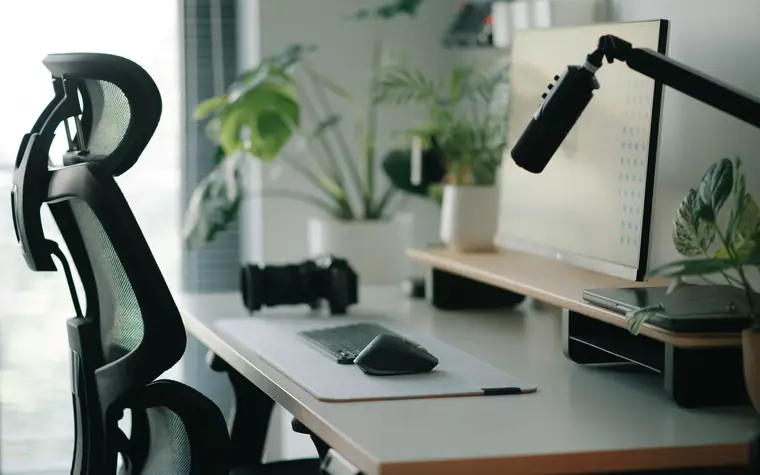
Start by Checking Your Desk Environment
The starting point of managing stiffness is your work environment. A desk and chair that don't fit your body will tense the muscles no matter how carefully you mind your posture. Check the following.
- Monitor height: Set the top of the screen at about eye level or slightly below. If the screen is too low, you keep tilting your head down.
- Screen distance: Using the distance at which your fingertips reach when you extend your arm (about 50–70 cm) as a guide, find a distance where the text is comfortable to read.
- Chair and backrest: Sit so that your back rests against the backrest and your lower back maintains its natural curve. Push your hips deep into the chair.
- Arms and shoulders: Place the desk and keyboard at a height where your elbows form roughly a right angle at your sides and your shoulders aren't tensed.
- Feet: Have the soles of your feet rest comfortably on the floor, and if they don't reach, use a footrest.
If you use only a laptop, the screen is low and it's easy to tilt your head down, so raising the screen with a stand and connecting a separate keyboard and mouse is much easier on the neck.
Preventing "Turtle Neck" with Posture Habits
The habit of dropping your head down low when looking at a smartphone shifts the weight forward onto the neck. The commonly mentioned "turtle neck" is understood not so much as the name of a specific disease but as an expression referring to the postural tendency of the head jutting forward of the shoulders. The key to prevention is raising the screen close to eye level.
- Raise your smartphone up in front of your face, close to eye level, to view it. Avoid keeping your head down for a long time.
- Remember the feeling of tucking your chin slightly, so that your ear and shoulder line up roughly in a straight line when viewed from the side.
- Occasionally check whether you've absentmindedly dropped your head down while moving or waiting.

Short Stretches Now and Then
The most effective habit is moving often. Getting up from your seat once every 30 minutes to an hour to loosen your body helps prevent the muscles from stiffening. Perform the movements below slowly and without bouncing, within a comfortable range that has no pain.
- Side-of-neck stretch: Lightly rest one hand on the opposite side of your head and slowly tilt your head to the side, holding the feeling of the side of your neck stretching for about 15 seconds. Alternate both sides.
- Shoulder-shrug release: Breathe in as you raise your shoulders toward your ears, then breathe out as you drop them down. Repeat several times to release tension.
- Shoulder rolls: Slowly roll your shoulders in large circles forward and backward to gently loosen the knotted areas.
- Chest opener: Lightly clasp both hands behind your back and push your chest forward, stretching the front muscles that had been hunched and drawn in.
With any movement, stop immediately if it feels painful or numb. Stretching should be to the degree of a "pleasant stretch," not forcing through pain.
Finishing with Warm Compresses and Rest
Applying a warm compress to knotted areas can help the muscles relax and feel comfortable. Common methods include showering with warm water or placing a warm compress pack on the back of the neck and shoulders. However, be careful with temperature and time so as not to get burned.
Sufficient sleep and rest are also important. If your pillow is too high when you sleep, your neck bends and it can feel stiffer in the morning, so a height that supports the natural curve of the neck is comfortable. Shoulders tensed all day grow much lighter just by practicing consciously releasing the tension. When you're absorbed in work and suddenly notice your shoulders have risen, try building the habit of breathing out and dropping your shoulders down.
Common Misconceptions
"When you're stiff, the harder you knead and pound, the better?" Pressing hard may feel momentarily relieving, but handling it too forcefully can actually startle the muscles into more tension or discomfort. Loosening gently and moving often is better.
"Just fixing your posture makes stiffness disappear?" Good posture is important, but no matter how good the posture, holding one posture for a long time tenses the muscles. More key than the posture itself is changing it often and moving.
"If you endure the knots and keep working, they heal on their own?" Mild stiffness can improve with rest and relaxation, but if pain or numbness continues, or there's a sensation shooting into the arm, it's safer to see a professional than to endure it.
Frequently Asked Questions
Q. How many times a day should I stretch?
There isn't a set number of times. What matters is doing it briefly and often rather than for a long time at once. Aiming for a rhythm of getting up to loosen your body for a moment every 30 minutes to an hour is manageable.
Q. For neck and shoulder stiffness, is a warm compress or a cold compress better?
For muscle tension from sitting a long time, a warm compress generally helps with relaxation in many cases. However, it can be different for an injured, swollen, or hot area, so if the situation is unclear or symptoms continue, it's good to consult a physician.
Q. In what cases should I go to the hospital?
If it doesn't improve even with rest and stretching and the pain persists, or there's a sensation of numbness shooting into the arm or hand, weakness, or severe pain, don't judge on your own; it's safe to see a specialist such as in orthopedics or neurology.
This article is general health information and does not replace medical diagnosis or treatment. If pain or numbness persists, consult a physician.
All content is fact-checked under our editorial standards.