
Stretches and Good Posture for People Who Sit and Work All Day
When a day of sitting down in the morning and rarely getting up until evening repeats itself, your neck and shoulders feel stiff and your lower back grows heavy — even though you didn't do anything particularly strenuous. Our bodies are built to move constantly, so staying fixed in one posture for a long time is itself a burden on the muscles and joints. In particular, as you focus on a screen, your head unknowingly juts forward and your back rounds; when this posture repeats for hours on end, the fatigue remains fully in your body by evening.
Fortunately, even without impressive equipment or a big resolution, just refining your posture a little and loosening your body now and then can make the day's stiffness noticeably lighter. This article summarizes posture habits and easy stretches that people who sit and work for long hours can practice in daily life.
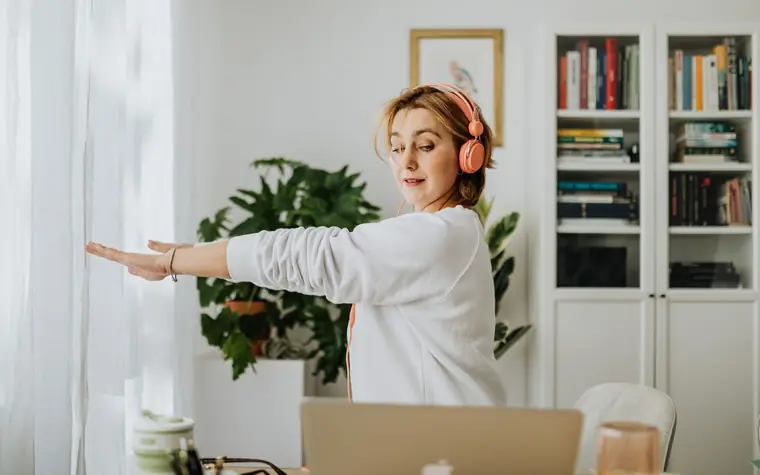
The Basics of Good Posture — Start with Screen and Chair Height
For people who sit and work for long hours, the first thing to check is the height of your workspace. Posture lasts much longer when the environment naturally creates it, rather than when you hold it up through willpower.
- Monitor height: Place the top of the screen at about eye level or slightly below. If the screen is too low, you keep tilting your head down, and strain builds in the neck.
- Monitor distance: A comfortable guideline is about the distance at which your fingertips reach the screen when you extend your arm (roughly one arm's length).
- Chair and lower back: Sit with your hips pushed deep into the backrest so that the natural curve of your lower back is maintained. If needed, support your lower back with a thin cushion.
- Feet and knees: It's best to have the soles of your feet flat on the floor at a height where your knees form roughly a right angle. If your feet dangle, use a footrest.
Rather than forcing your neck and back ramrod straight, the key is to relax and find a natural, neutral posture. Drop your shoulders down and away from your ears, and tuck your chin slightly so your head doesn't lean forward. Place your keyboard and mouse where your elbows form roughly a right angle, so your wrists aren't bent excessively. Once you set up an arrangement that puts less strain on the body, a comfortable state is maintained naturally without your having to constantly mind your posture.
The Best Posture Is One You "Change Often"
More important than holding a perfect posture all day is not holding the same posture for a long time. No matter how good the posture, staying fixed for hours concentrates strain on specific areas and slows blood circulation. So it's recommended to get up from your seat once every 30 minutes to an hour to drink water or take a light walk. Even just looking out the window for a moment or taking a lap around the hallway can give you the feeling of your body resetting.
Using an alarm or timer makes it easy to remember to do this even when you're absorbed in work. It's also a good idea to weave movement into your daily paths — taking phone calls standing up, or placing the printer or water dispenser a little farther away so you naturally walk. If your setting allows working while standing, alternating between sitting and standing also helps distribute the strain.
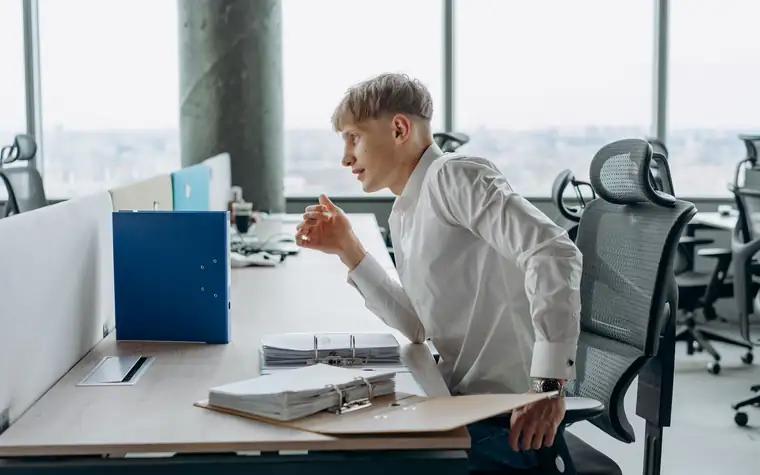
Simple Stretches You Can Follow Without Strain
The movements below are gentle stretches you can do even in an office chair. Don't push forcefully to the point of pain; stop at a pleasant stretching sensation. Move slowly without bouncing, and keep your breathing easy.
- Side-of-neck stretch: With one hand, gently hold the opposite side of your head and softly pull your ear toward your shoulder. Hold for 15–20 seconds and do the same on the other side.
- Shoulder rolls: Slowly roll both shoulders in large circles, a few times forward and a few times backward. This releases tension around tight shoulders.
- Chest opener: While seated, lightly clasp both hands behind you and push your chest forward to open it up. This stretches a hunched upper body in the opposite direction.
- Torso twist: While seated, slowly turn your upper body to one side and pause briefly. Don't force your back to twist; alternate left and right within a comfortable range.
Adding a movement of lightly clenching and opening your wrists and fingers can also loosen hands made stiff by typing. Stretching is more effective for keeping the body supple when done briefly but several times a day than for a long time at once. Setting a few moments in the day — before sitting down in the morning, after lunch, when you feel drowsy in the afternoon — makes it easy to establish as a habit.
These movements are just general stretches to loosen the body, not a prescription that treats a specific condition or eliminates pain. If you feel numbness or sharp pain, stop immediately and stay within a range that doesn't strain you.
Common Misconceptions
The idea that "as long as your posture is correct, sitting for however long is fine" is a misconception. Even with good posture, staying fixed for a long time burdens the body. More important than good posture is moving often.
Also, the idea that "correct posture means forcing your back rigidly straight" is a common misconception. A stiff posture with the whole body tensed actually strains the muscles. It's better to relax and maintain a natural curve. Nor does one expensive chair solve everything. In the end, the habit of getting up and moving now and then is what matters most.
Frequently Asked Questions (FAQ)
Q. How often should I get up?
There's no set answer, but many experts recommend getting up from your seat to move a little about once every 30 minutes to an hour. Linking it to everyday actions — going to the restroom or drinking water — makes it easy to practice.
Q. When is the best time to stretch?
There's no particular set time. Just do it lightly when your body feels stiff, or while you're getting up after sitting for a long time. Doing it often, even briefly, is more helpful than doing it all at once. However, avoid forcing a stretch while in pain, and it's safe to stop at a comfortable stretching sensation.
Q. Is using a standing desk unconditionally better than sitting?
A standing posture, too, can burden the legs and lower back if held for a long time. What matters is not sitting versus standing, but not holding one posture for a long time. Alternating appropriately between sitting and standing, and walking or loosening up briefly in between, is most ideal. Whatever tool you use, in the end it only works when backed by the "habit of moving often."
This article is general health information and does not replace medical diagnosis or treatment. If pain is severe or persists, consult a physician.
All content is fact-checked under our editorial standards.