
Turning 65 Brings Two Dental Implants and Dentures Into Health Insurance — 30% Co-payment, and Registration Has to Come First
There is one sentence that comes up over and over after a dental consultation for an older parent: "I thought insurance covered this — why is the quote so high?" It is true that turning 65 brings dental implants and dentures into national health insurance coverage. But how many, in what oral condition, and with which materials are all fixed by rule, and missing any one of those conditions means paying the whole bill yourself. On top of that, there is a registration step with the insurance service that has to happen before treatment. Go ahead without it and coverage will not be applied retroactively. Here is the coverage framework as the National Health Insurance Service sets it out, item by item.

Implants and dentures share an age rule and almost nothing else
Both benefits start at age 65. That is where the similarity ends. The quantity limit, the interval before you can claim again, and the co-payment rate are each designed differently.
The point that trips people up most often is this. Implants are capped at two in a lifetime — a budget that, once spent, is gone. Dentures run on a once-every-seven-years cycle that refills. They are different kinds of limit, so filing them in memory as "two of each" will produce the wrong sum.
Implants — two for life, and the "partially edentulous" condition
Coverage applies to subscribers or dependants aged 65 or over who are partially edentulous. This is where a lot of people fall out. If no teeth remain at all, a completely edentulous patient is not eligible for implant coverage. That case is routed to dentures instead.
The quantity is two per person for life. Since 1 July 2015 coverage applies to every tooth position with no distinction between upper and lower jaw, so two on top or one on each is equally fine. Where treatment is discontinued for medical reasons, that attempt does not count against the two.
The materials and scope that qualify are also specified.
- Only two-piece fixture systems qualify. Use a one-piece fixture and it is not a covered procedure.
- The prosthetic is a porcelain-fused-to-metal (PFM) crown. Choose zirconia or another material and that treatment falls outside the covered scope.
- Fixtures placed through the maxillary bone are excluded.
Costs are calculated in stages: diagnosis and treatment planning, fixture placement, then prosthetic restoration. When the clinic asks whether you want "the insured implant or a private-pay material," this materials rule is the reason.
The co-payment is 30% — but the annual cap does not apply
For insured patients the co-payment is 30% of the total covered treatment cost, with no difference between inpatient and outpatient settings.
Here is the part that gets missed. The out-of-pocket ceiling scheme does not apply to dental implant co-payments. There is a system that refunds the excess when your medical spending for the year passes a threshold, but this item is not counted toward it. Which means that when you work out what the out-of-pocket ceiling can refund, implant costs should not go into the calculation.
Dentures — once in seven years, and only certain types
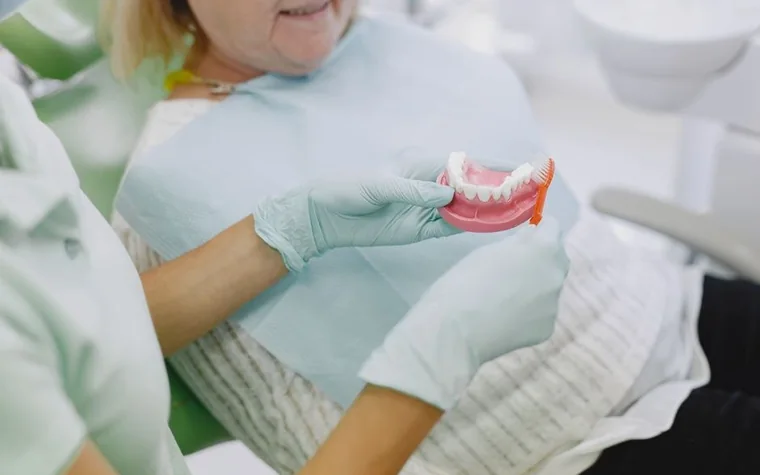
Dentures also start at 65. The covered types are as follows.
- Complete dentures: resin-based and metal-based
- Partial dentures: clasp-retained metal-based only
The interval is once every seven years, applied separately to complete and partial dentures. Make a new set inside that window and you pay the full cost. There is an exception: where the oral condition has changed seriously and remaking is judged medically necessary, one additional remake is possible. That judgment runs through the clinic and the insurance service.
The co-payment is the same 30% as for implants. Dentures also carry a separate maintenance benefit: eight items including relining, repair and adjustment of the denture base are covered, each allowed between one and four times a year. Adjustments for a denture that has worked loose are therefore covered too — worth knowing after the set is made, not just before.
What happens if you change clinics partway through
This question comes up a lot. Denture fabrication is billed across five stages for complete dentures and six for partial dentures. So if you move to a different clinic partway, you are charged only for the stages completed up to that point. You do not start paying from zero again.
Implants are staged in the same way. Because these are treatments that run over months, knowing the structure lets you work out the actual loss if circumstances force a change of clinic.
The reduced rates differ between implants and dentures
This is the detail that causes the most confusion in practice. The two benefits are not discounted at the same rate.
| Category | Dental implant | Senior denture |
|---|---|---|
| Health insurance subscriber | 30% | 30% |
| Near-poor, rare/intractable disease | 10% | 5% |
| Near-poor, chronic disease | 20% | 15% |
| Medical Aid type 1 | 10% | 5% |
| Medical Aid type 2 | 20% | 15% |
In other words the denture reduction is five percentage points deeper than the implant one at every tier. Read one leaflet, memorise "my father pays 5%," and the implant invoice will not add up. Near-poor and Medical Aid recipients are also outside the out-of-pocket ceiling scheme.
Registration has to come before coverage
This is the most important procedural step. Meeting the age condition does not switch coverage on by itself. Registration as an eligible patient has to be in place before treatment.
- Health insurance subscribers: the clinic verifies and submits the registration form to a local NHIS branch, and treatment follows once registration is confirmed.
- Medical Aid recipients: the channel is different. The medical aid institution issues the registration form, and the recipient must submit and register it in person at the district office within seven days, excluding public holidays, before treatment. Denture registration also goes through the district office only.
Reversing the order creates a problem. You cannot have treatment first and ask for it to be reclassified as covered afterwards. Ask at the consultation stage when registration happens.

The order to check things in
- Confirm age 65 has been reached, and whether the mouth is partially or completely edentulous. Completely edentulous means dentures, not implants.
- Check how many of the two lifetime implants have already been used. The insurance service holds the record.
- For dentures, check whether seven years have passed since the last set.
- If you are a near-poor or Medical Aid recipient, note that the rate differs between implants and dentures.
- At the consultation, confirm explicitly that covered materials will be used — a two-piece fixture and a PFM crown.
- Register first, then book the treatment date. Medical Aid recipients should watch the seven-day district office deadline.
If you are managing a parent's medical costs generally, it is worth reading our pieces on applying for a long-term care grade and checking eligibility for the national health check-up alongside this. Whatever coverage does not pick up should be checked separately against the terms of your indemnity medical insurance policy — dental work is an area thick with exclusions, and outcomes differ by policy generation.
Sources. National Health Insurance Service, "Dental Implant Benefit Guide" — subscribers and dependants aged 65 or over who are partially edentulous (completely edentulous excluded); two per person for life; from 1 July 2015 covered at all tooth positions with no upper/lower distinction; co-payment 30% of total covered cost with no inpatient/outpatient distinction; out-of-pocket ceiling not applied; near-poor rare/intractable disease 10% and chronic disease 20%; Medical Aid type 1 10% and type 2 20%; covered materials are two-piece fixtures and porcelain-fused-to-metal crowns; one-piece fixtures, prosthetic materials other than PFM crowns and placement through the maxillary bone are excluded; stages are diagnosis and treatment planning, fixture placement and prosthetic restoration; the treating institution submits the eligibility registration form to the insurance service before treatment; Medical Aid recipients must submit the issued form to the district office within seven days excluding public holidays. National Health Insurance Service, "Senior Denture Benefit Guide" (Enforcement Decree of the National Health Insurance Act, Article 19(1), Annex 2) — age 65 or over; complete dentures in resin and metal base and partial dentures in clasp-retained metal base; once every seven years, with one additional remake possible where a serious change in oral condition makes it medically necessary; co-payment 30%; near-poor rare/intractable disease 5% and chronic disease 15%; Medical Aid type 1 5% and type 2 15%; five stages for complete dentures and six for partial dentures, so a change of institution partway means paying only for stages completed; maintenance benefit of eight items at one to four times per year each; Medical Aid recipients register through the district office. Checked August 2026. Benefit criteria and co-payment rates can change by notification and application varies with individual oral condition, so confirm eligibility and amounts with your treating dental clinic and the National Health Insurance Service (1577-1000). This article sets out health insurance coverage rules; it does not offer diagnosis or treatment guidance and does not replace the judgment of a medical professional.
All content is fact-checked under our editorial standards.