
Nursing Hospital Caregiving Costs Get Health Insurance Coverage Next Year — Which Hospitals Qualify and the 30% Co-Pay
If you have a parent in a nursing hospital, you've likely been paying the full caregiving fee out of pocket -- often 2 to 3 million won a month -- because caregiving has never been covered by national health insurance. The government is now expanding a pilot program that brings this cost under insurance coverage, so it's worth knowing which hospitals qualify and when the change actually reaches your bill.

Why it's been 100% out of pocket until now
Caregiving services for patients admitted to nursing hospitals were never a covered health insurance item -- patients and families either hired a private caregiver directly or paid whatever fee the hospital's referred caregiver charged, entirely out of pocket. Whether one caregiver looked after several patients or it was one-on-one care, it was uncovered either way, and the cost was heavy enough that many families ended up staying at the hospital themselves to provide care. This '100% patient-paid caregiving' structure is exactly what the government is trying to change with this policy, which it has made a national priority.
The rollout timeline — from 10 hospitals to 200, full coverage by 2027
The caregiving coverage program first ran as a pilot at 10 nursing hospitals nationwide from July 2024 through December 2025. That phase tested a model where hospitals directly employ caregiving staff, focusing on how much the co-pay actually dropped and whether hospitals could secure enough caregiving workers. The government now plans to select an additional 200 nursing hospitals meeting a quality and service standard sometime in the second half of 2026, expanding coverage to roughly 20,000 high-acuity patients, and after this staged pilot, the program is set to convert from a pilot into a permanent health insurance benefit starting January 2027. The expansion applies first to hospitals with 100 or more beds that directly employ their caregiving staff -- not every nursing hospital qualifies at once, since both bed count and staffing structure have to be met first.
Which patients first — severe, rare, dementia, Parkinson's
Even at a qualifying hospital, not every admitted patient is covered right away. Coverage expands in stages starting with patients who have severe, rare, or intractable conditions, and those with dementia or Parkinson's disease whose acuity requires round-the-clock caregiving. Patients who are relatively mobile or have milder conditions may fall outside this expansion phase. Because acuity classification can differ patient by patient even within the same hospital, some beds may be covered while others in the same ward remain out of pocket -- it's worth asking the care team directly where your family member's classification falls.
How much does the co-pay actually drop — toward 30%
Once coverage applies, health insurance picks up a substantial share of what used to be a fully out-of-pocket caregiving fee, bringing the patient's co-pay down to roughly 30% under the current design. The exact amount still depends on the hospital's staffing structure and the patient's acuity classification, so if you're told your hospital now qualifies, the most reliable way to confirm the change is to compare the caregiving line item on next month's actual bill.

This is not the same program as long-term care grading
Here's where confusion often sets in. If your family has already applied for and received a long-term care grade, that grade covers home-based benefits (visiting care, day/night care) or nursing facility benefits under the long-term care insurance system -- a different legal basis and operator entirely from the 'caregiving during a nursing hospital stay' now being covered. A long-term care grade is assessed by the National Health Insurance Service and delivered by care workers visiting the home or a facility, while this new policy covers caregiving staff directly employed by a nursing hospital for patients admitted there. Already having a long-term care grade doesn't automatically bring your parent's nursing hospital caregiving fee under coverage -- and conversely, a patient without a grade can still qualify if admitted to a covered nursing hospital.
Staffing is the real bottleneck — and the hospital applies, not the family
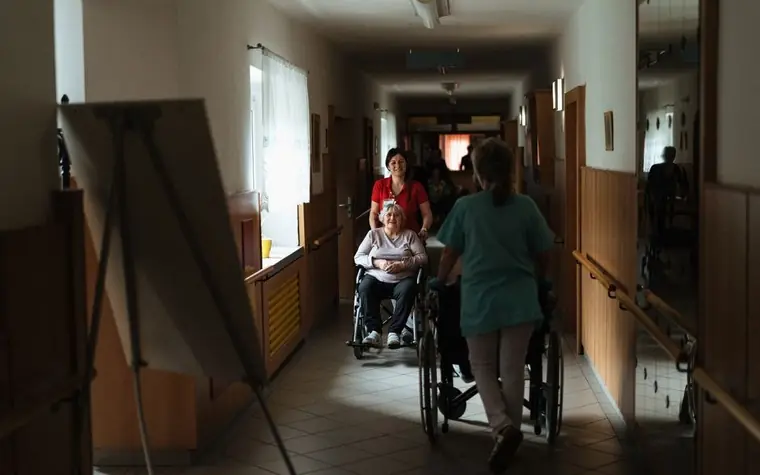
This isn't a program patients or families apply for individually -- a hospital only becomes a qualifying site once it directly employs enough caregiving staff to meet the government's standard. So the practical step for a family is not to file an application, but to ask the hospital's administrative or social work office whether the nursing hospital your parent is in (or considering) is already a designated pilot site, or plans to apply soon. Hospitals that can't secure enough caregiving staff may see their designation delayed even if they meet the bed-count requirement, so timing and coverage scope can vary by region and by hospital.
If the cost is still a burden right now — check these other programs
If your parent's hospital doesn't yet qualify and the caregiving cost remains heavy, it's worth separately checking programs like catastrophic medical expense support, which lowers the burden of medical costs themselves, or emergency welfare medical assistance for households facing a sudden drop in income or assets. If an elderly parent also needs dentures or implants, don't overlook health insurance coverage for implants and dentures at age 65+. Each of these programs has its own eligibility criteria and application window, so check individually with the hospital's administrative office, a hospital social worker, or the National Health Insurance Service.
Steps to check
1) Ask the administrative office whether your parent's nursing hospital has 100+ beds and directly employs its caregiving staff. 2) Check whether the hospital is one of the 10 first-phase pilot sites, or among the 200 hospitals in the 2026 second-half expansion. 3) If it qualifies, confirm whether the patient falls under a priority category -- severe illness, dementia, Parkinson's, and so on. 4) Once coverage starts, compare the caregiving line item and co-pay rate directly on the bill. 5) If not covered, review catastrophic medical expense support or emergency welfare medical assistance with a hospital social worker. This article is general information about a health insurance coverage expansion plan and does not advise on any individual hospital's eligibility or on caregiving or treatment methods. Confirm the exact timing and co-pay amount with the nursing hospital and the National Health Insurance Service.
All content is fact-checked under our editorial standards.