
How to Start Running Without Wrecking Your Knees -- The Four Spots Behind 90% of the Pain, and the '10% Rule'
Fall is when a lot of people decide to start running. But plenty of beginner runners who jump in without preparation are sidelined by knee pain within a few weeks. Knee injuries are by far the number one running injury, and the pain almost always starts in one of a handful of predictable spots. Knowing where it hurts and why gives you a good sense of how fast you can safely ramp up.

90% of Runner's Knee Pain Starts in a Few Fixed Spots
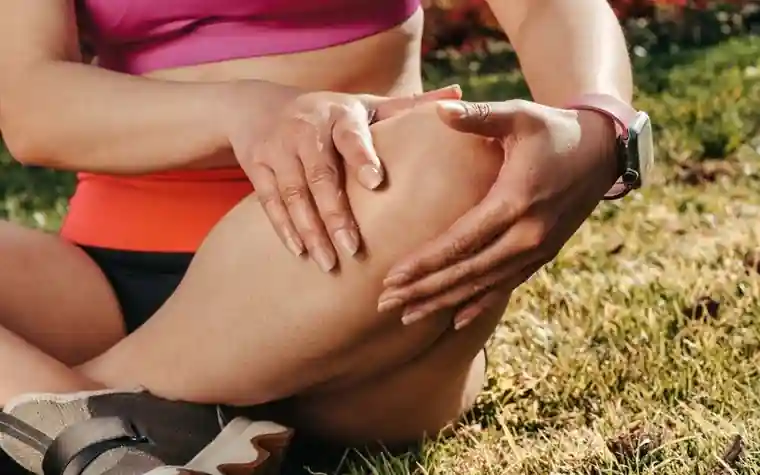
Orthopedic doctors who have completed multiple marathons and 100km ultramarathons say runner's knee pain generally falls into four locations. Pain just below the kneecap is usually patellar tendinitis (jumper's knee), caused by impact on landing. Pain on the inside of the knee -- medial collateral ligament (MCL) irritation -- is described as the most common complaint among runners. A burning pain on the outside of the knee points to iliotibial band syndrome, which tends to show up after repeated laps on a track or curves. Pain where three tendons meet just below the inner knee may be pes anserine tendinitis. On top of these, a stinging pain at the front of the kneecap that gets worse going up and down stairs -- patellofemoral pain, or runner's knee -- is also common in beginners. Pinpointing the location alone narrows down the likely cause.
The '10% Rule' -- Never Add More Than 10% Over Last Week
The principle mentioned most often in injury prevention is not increasing your total weekly running distance by more than 10% over the previous week. Leg muscles can adapt within a day or two, but connective tissue like ligaments and cartilage strengthens far more slowly than muscle. If you push distance up too quickly, your muscles may hold up while the tissue around your knee can't keep pace, leading to stress fractures or overuse pain. If you ran 5km this week, capping next week at around 5.5km and building up gradually over several weeks is the safer approach.
Telling Pain Apart -- What You Can Run Through, and What Means Stop Now
Not all pain carries the same weight. General stiffness after a run can often be handled with a day or two of rest and a lighter reload, but if the knee is swollen or there's a specific spot that hurts sharply when pressed, the rule is to stop on the spot. Pes anserine tendinitis in particular has been known to escalate quickly enough to send runners to the emergency room. If pain lasts more than two weeks, stop trying to manage it yourself and see a doctor. Separate from a national health checkup, pain that shows up during exercise calls for an orthopedic consultation first.
The Surface You Run On Changes the Load on Your Knees
Running the same distance on different surfaces sends very different amounts of shock through your knees. Concrete is the most punishing surface, and paving blocks or uneven dirt trails also carry a heavy load. By contrast, asphalt, rubberized tracks, and treadmills transmit relatively less impact. If you can't change your route every time, avoiding long concrete stretches and mixing in a park's rubber track or a school field can meaningfully cut down on the strain your knees absorb.
Running Fast Can Be More Dangerous Than Running Far
It's easy to assume distance is the only thing to watch, but many experts point out that suddenly increasing speed carries more injury risk. A short, all-out sprint delivers a far greater instantaneous shock to the knees and ankles than a longer, slower run. In the first few weeks before your body has adapted, it's safer to prioritize "can I finish comfortably" over distance, and distance over speed.
Five Minutes Before You Run -- Loosen the Hips, Thighs, and Calves
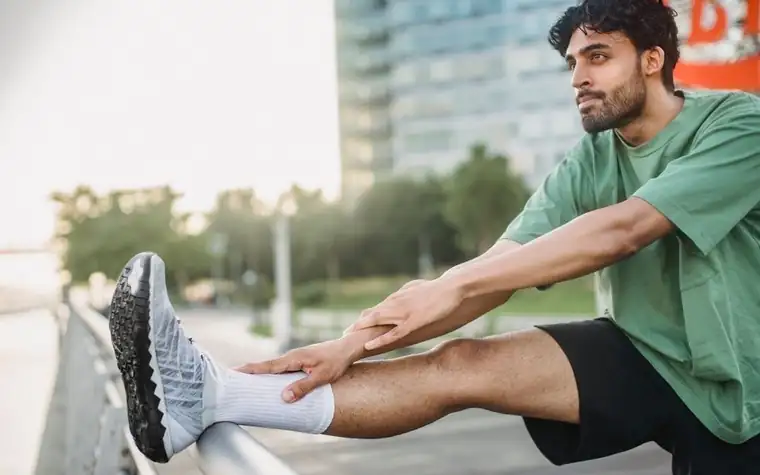
Skipping a warm-up is cited as one of the leading causes of runner's knee. Before running, it helps to loosen up in order -- hips, front and back of the thighs, then calves -- and a hip-hinge stretch done with a straight back is especially useful. You can borrow the hip and thigh loosening moves from desk-worker stretches and use them directly as your pre-run routine. The longer you sit during the day, the more likely your hip flexibility has declined, so this step is worth not skipping.
Do You Actually Need a Knee Brace?
More beginner runners are buying knee braces to wear preemptively, but the general consensus is that wearing one routinely, absent any pain, isn't necessary. What matters more than a brace is a plan for increasing distance slowly and a proper warm-up. Wearing a brace temporarily to protect an area that's already been injured is a different matter from wearing one every time as prevention. Even outside running, when starting another activity that stresses the knees, the same approach to prioritizing protective gear is worth applying.
Quick Recap
① For the first few weeks, judge success by whether you can finish comfortably, not distance. ② Keep your weekly total distance increase within 10% of the previous week. ③ Spend about five minutes loosening your hips, thighs, and calves before you run. ④ Where possible, choose asphalt, a rubberized track, or a treadmill over concrete. ⑤ If your knee swells or there's a sharp, specific point of pain, stop immediately and drop back down to walking before building up again. ⑥ If the pain lasts more than two weeks, see an orthopedic specialist.
This article summarizes general exercise knowledge and is not a substitute for a medical professional's diagnosis of the cause of your pain or its treatment.
All content is fact-checked under our editorial standards.