
Damaged or Lost Parcel? You Have 14 Days From Receipt to Notify — and a KRW 500,000 Cap If You Skipped the Value Box
When a parcel arrives smashed, or the box someone left at your door is gone, the first move is usually a call to customer service. But these disputes are decided less by that call than by two dates and one box on the waybill. Courier service in Korea is governed in practice by the Fair Trade Commission's Standard Terms No. 10026, and written into it are a 14-day notice deadline and a KRW 500,000 compensation cap. Miss either and a claim that should have paid out does not.
Past 14 days, liability disappears
Article 25(1) of the Standard Terms provides that the carrier's liability for partial loss of or damage to goods is extinguished unless the consignee notifies the carrier within 14 days of the date the goods were received.
Two details matter. The clock starts on the date of receipt, not the date of the delivery-complete text message, and the notice must reach the carrier. It is common for someone to tell only the seller and let two weeks run out. The seller and the courier are separate contracting parties.
Deadlines that extinguish a consumer right outright are not unusual in this area — the 60-day rule for reporting fraudulent card use works the same way. In practice the safest form of notice is one that generates a case number. Whether by app chat or phone, choose the channel that records the fact and date of your report. Opening the box late because you were travelling does not extend the 14 days.
The claim itself runs one year, or five if concealed
Separately from notice, the claim has its own limitation period. Article 25(2) extinguishes liability for partial loss, damage or delay one year from the date of receipt, and for total loss — where there is no receipt date — the year runs from the scheduled delivery date.
There is one exception. Where the carrier or its employee wilfully concealed the facts, Article 25(3) applies a five-year period. That covers cases where it later emerges that damage was known about and processed as a normal delivery anyway.
The declared value box sets your ceiling
This is the part with real money in it. Article 22 splits the outcome depending on whether the customer declared the value of the goods on the waybill.
- Declared — damages are calculated on the value stated on the waybill.
- Not declared — the compensation cap is KRW 500,000. Where a surcharge was paid according to the value of the goods, the cap becomes the maximum value of that surcharge band.
So if you ship an item worth KRW 800,000 without declaring the value and it is lost entirely, the ceiling is KRW 500,000 regardless of what the item cost. Declaring the value adds a surcharge but raises the ceiling. The structure punishes saving a few hundred won at the risk of hundreds of thousands.
The valuation point also differs by case. Total loss is valued at the place and date the goods were scheduled to be delivered; partial loss at the place and date of actual delivery. And where the loss stems from wilful misconduct or gross negligence of the carrier or its employee, the caps fall away and all damages must be paid.

The exemptions are narrower than people assume
The carrier's responsibility begins when it takes the goods from the customer (Art. 20). That starting point is unchanged even where delivery is performed under an agreement with another carrier or using a third party's transport (Art. 21).
Exemption is confined to loss, damage or delay caused by force majeure, including natural disaster (Art. 24). "You consented to doorstep delivery, so we are not liable" is not, by itself, a ground for exemption. Even where a customer signed a waiver, the carrier is unlikely to escape liability without showing that it exercised the care required for safe carriage.
That said, some items should never be shipped at all. Cash, securities and precious metals are among the categories the Standard Terms allow a carrier to refuse, and consignments of that kind often fall outside the normal compensation structure when something goes wrong. The habit of posting original contract documents is risky for the same reason.
What you actually need to keep
A dispute ultimately turns on who can prove the condition of the goods at receipt. None of the five items below can be created after the fact.
- Photographs of the unopened box — one showing the waybill, one showing the damage.
- An unboxing video — for anything valuable, film the opening in a single unbroken take. This is the strongest evidence available.
- The delivery-complete photo — the doorstep image in the app can disappear over time, so save it immediately.
- Receipts and transaction records — these support the amount of loss even if you did not declare a value.
- Proof of notice — the date and case number. It is the only evidence of the 14-day requirement.
If customer service stonewalls you
Standard terms define the contract; they do not force a dispute to end. If the carrier refuses to pay, the escalation path is the 1372 consumer counselling centre, then a recommendation to settle, then redress through the Korea Consumer Agency, then mediation by the Consumer Dispute Settlement Commission. A mediated outcome carries legal effect.
If that route is unfamiliar, telecommunications dispute mediation has the same shape: no filing fee, and a fixed statutory processing period.
Where the amount is large and the other side will not engage, civil procedure remains. A payment order is quick for small sums, but as set out in why account freezes rarely work in secondhand-trading fraud, the first question is always whether you can identify the other party. With a courier that party is a company, which makes this step easier than usual.
What the sender can do in advance
The recipient's options are mostly reactive. The sender can change the outcome before anything happens.
- Declare the value. It is the only way past the KRW 500,000 cap. A surcharge applies, but the ceiling then tracks the real value.
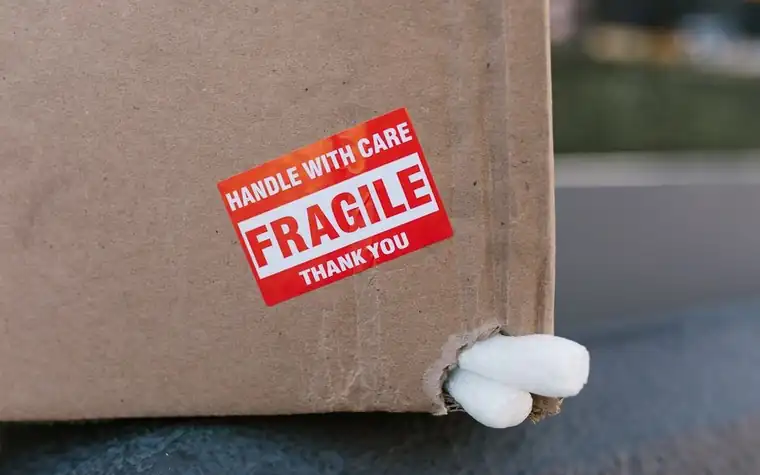
- Do not rely on fragile stickers. A sticker is a handling request, not a basis for compensation. Actual padding works better.
- Specify how it is handed over. Doorstep delivery is often the default, so switch valuable items to in-person receipt or a parcel locker.
- Keep a copy of the waybill. It is the only way to confirm later whether a value was declared.
Losses and misdeliveries rise when volume spikes ahead of the holidays. Like discounts that only apply if you apply for them, courier compensation does not proceed on its own. Counting the 14 days is the consumer's job from the start.

The order of operations
- Check the outside of the box where you take delivery, and if anything looks wrong, photograph it before opening.
- On finding damage or loss, notify the carrier within 14 days of receipt and get a case number.
- Check whether the waybill has a declared value. If not, the cap is KRW 500,000 — or the top of the surcharge band if one was paid.
- Assemble receipts and unboxing footage to establish the loss, then claim.
- If refused, escalate through 1372, Korea Consumer Agency redress, and dispute mediation.
- Where wilful misconduct or gross negligence is suspected, argue for full damages irrespective of the cap.
This article summarises the Fair Trade Commission's standard courier terms (No. 10026) and is not a substitute for legal advice on an individual case. Some carriers use terms that differ from the standard form, so in an actual dispute check the reverse of the waybill and that carrier's own terms.
All content is fact-checked under our editorial standards.